
Imperial IPS-dimensioned rigid PVC pressure pipe for industrial process water, Saudi Aramco utility networks, booster risers, and chemical plant piping. Schedule 40 and Schedule 80 wall thicknesses, 1/2" to 8" NPS, manufactured in Jeddah.
Direct pricing from the Jeddah plant, with technical submittal support.
Product photos from ALFA assets and supporting catalogue imagery for this family — for visual reference during specification and RFQ.
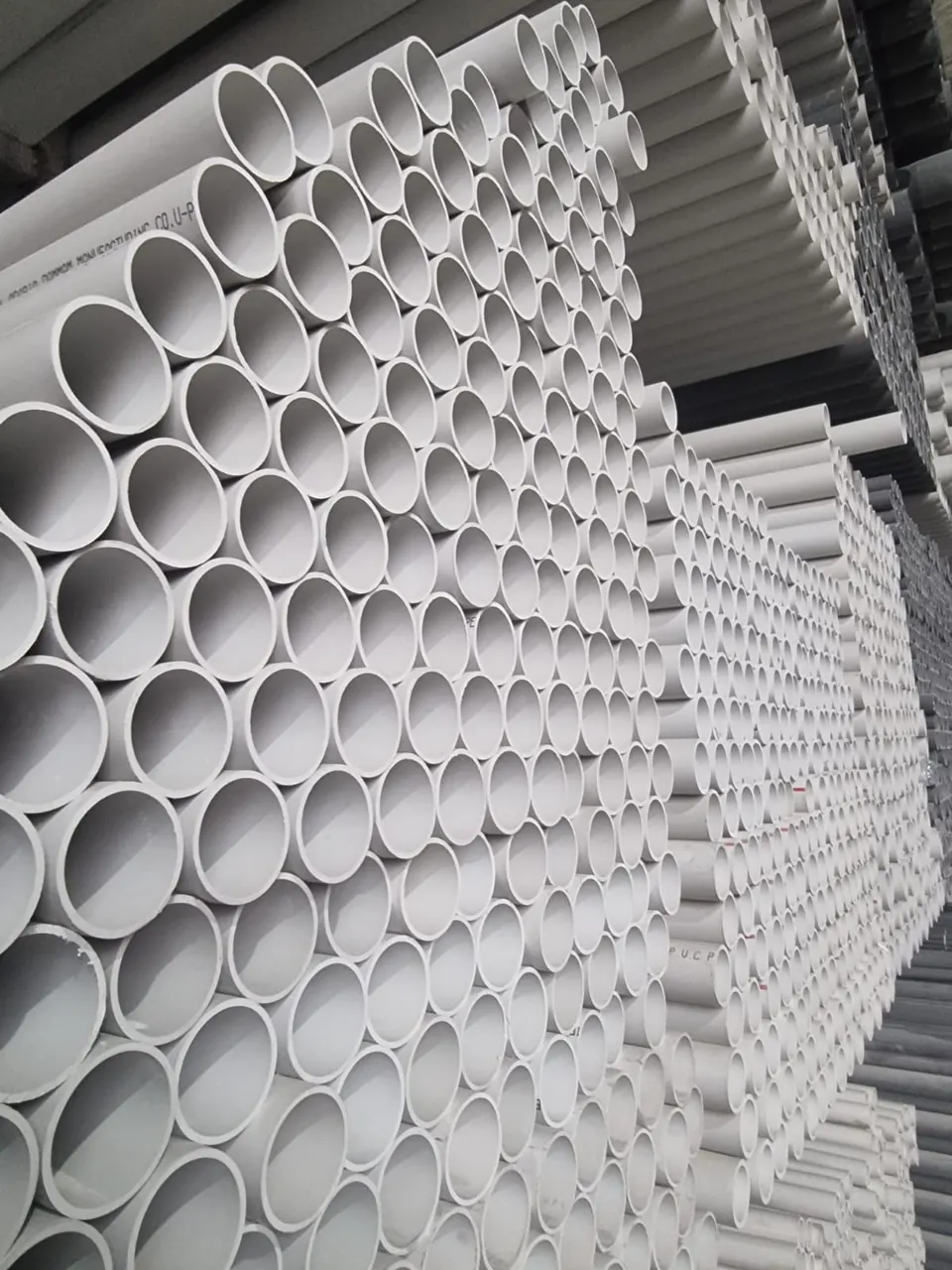
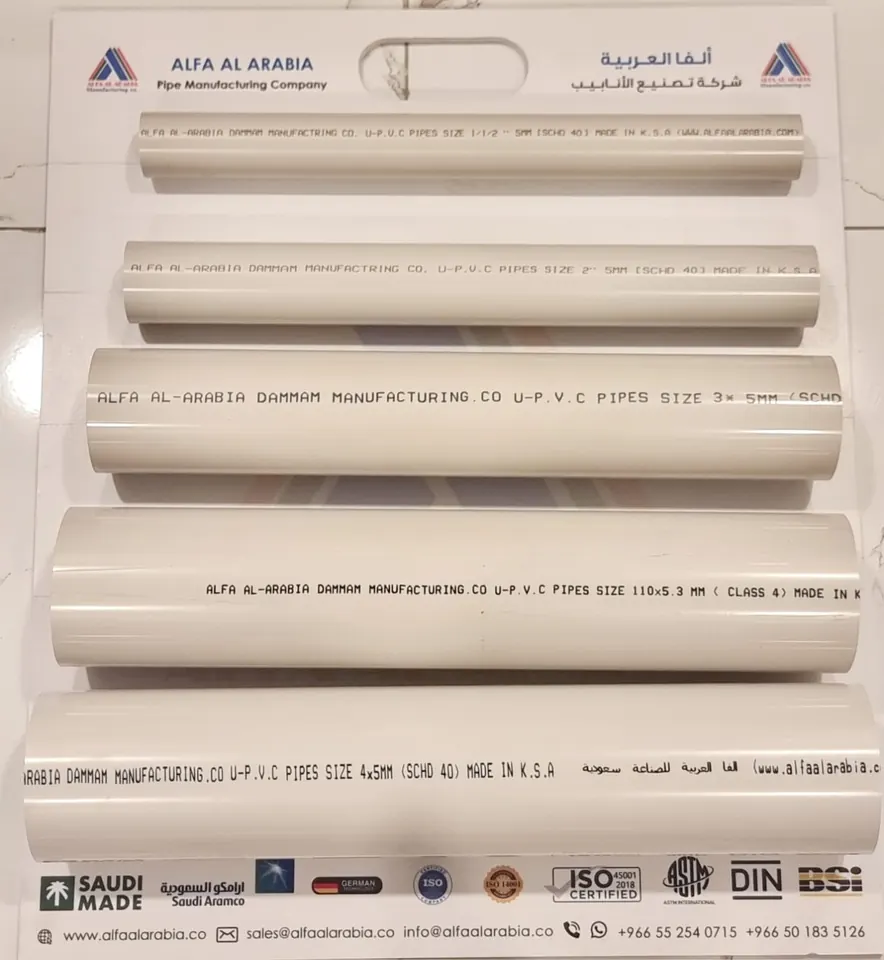
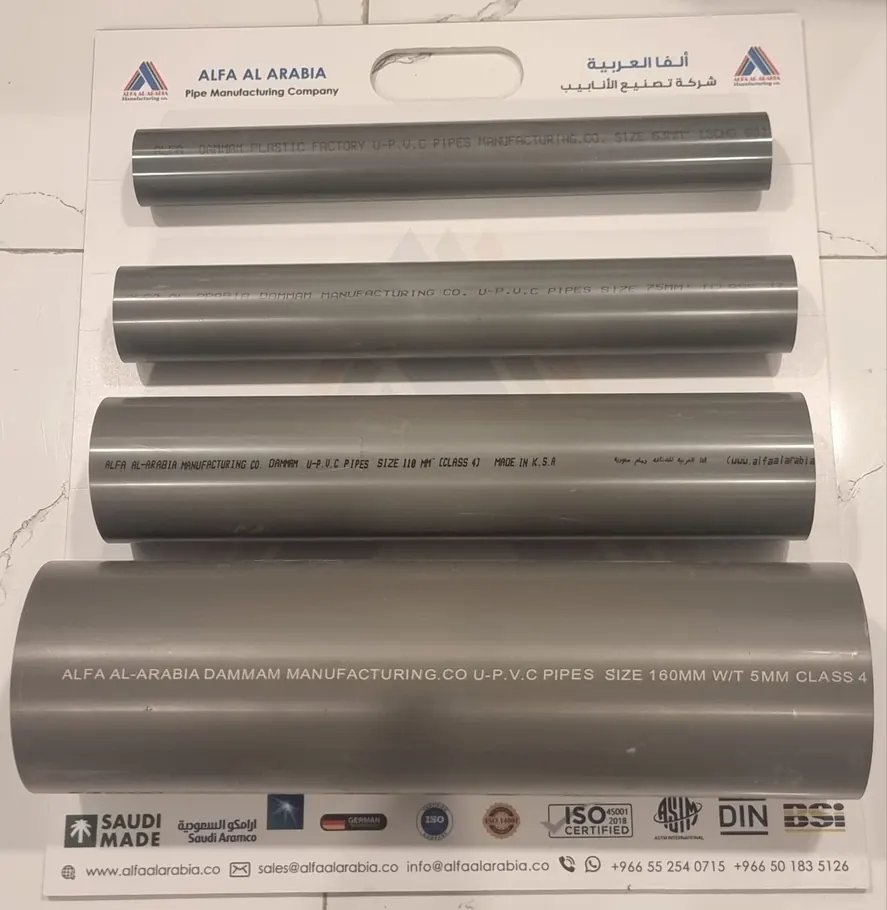
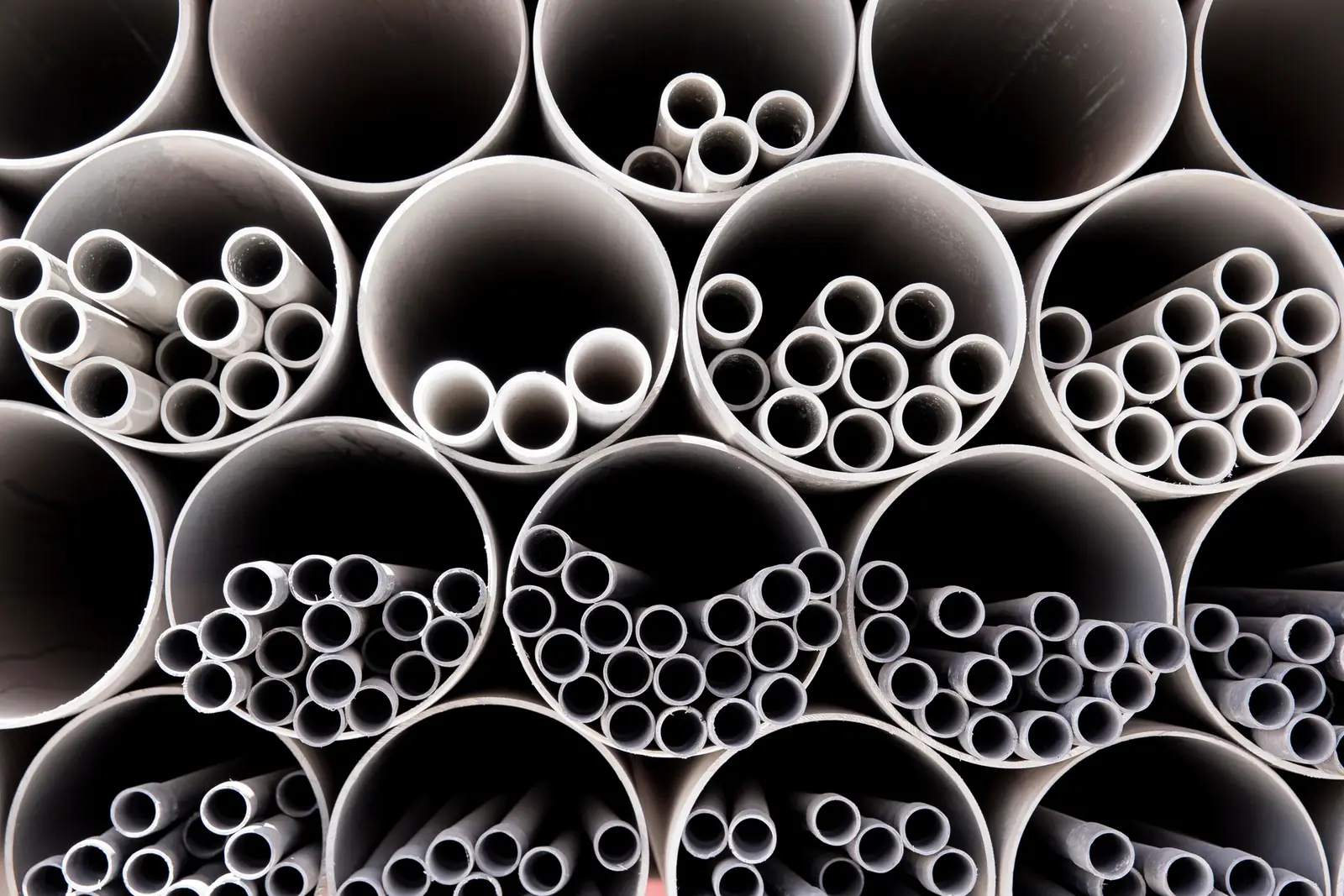
ALFA AL-ARABIA ASTM D1785 uPVC pressure pipes use Imperial Iron Pipe Size (IPS) dimensions with Schedule 40 (standard wall) and Schedule 80 (heavy wall) thicknesses. Schedule 80 provides approximately 50-75% greater wall thickness than Schedule 40 for the same nominal size, enabling higher working pressures and compatibility with threaded connections. These pipes are manufactured from the same lead-free Ca-Zn stabilized uPVC compound as our DIN 8062 series, but dimensioned to ASTM/ANSI standards for compatibility with North American and Saudi Aramco specification requirements.
| Standard | ASTM D1785, ASTM D2241, ASTM D2467 |
|---|---|
| Material | uPVC (PVC-U) — Lead-Free Ca-Zn Stabilizer |
| Pressure Classes | Schedule 40 & Schedule 80 |
| Size Range | 1/2" to 8" NPS (IPS Dimensions) |
| Jointing | Solvent Cement Socket (ASTM D2467/D2466) |
| Color | Dark Grey / White |
| Standard Length | 6.0 m (20 ft equivalent) |
| Aramco Vendor | #10116102 |
ASTM D1785 is the American Society for Testing and Materials standard specification for poly(vinyl chloride) (PVC) plastic pipe in Schedules 40, 80, and 120. It defines the outside diameters, wall thicknesses, material properties, and performance requirements for rigid PVC pipe using Iron Pipe Size (IPS) dimensions. The 'Schedule' concept is borrowed from metallic piping: Schedule 40 represents standard-wall pipe while Schedule 80 represents extra-heavy-wall pipe with proportionally greater wall thickness.
In Saudi Arabia, ASTM D1785 is primarily specified for two reasons. First, Saudi Aramco engineering standards reference ASTM pipe dimensions throughout their piping specifications for non-metallic utility systems, making Schedule 40/80 PVC the standard for Aramco compound piping, camp facilities, and industrial utility networks. Second, many international engineering consultants working on Saudi mega-projects specify ASTM-dimensioned pipe for compatibility with their standard designs and calculation templates.
The key difference from DIN 8062 metric pipe is purely dimensional. DIN 8062 uses metric outside diameters (20, 25, 32, 40, 50, 63, 75, 90, 110 mm...) while ASTM D1785 uses IPS outside diameters (0.840", 1.050", 1.315", 1.660", 1.900", 2.375", 2.875", 3.500"...). The material, manufacturing process, and performance characteristics are essentially identical.
| NPS | OD (in) | OD (mm) | Wall (in) | Wall (mm) | ID (in) | Working Pressure (psi) |
|---|---|---|---|---|---|---|
| 1/2" | 0.840 | 21.3 | 0.109 | 2.77 | 0.622 | 600 |
| 3/4" | 1.050 | 26.7 | 0.113 | 2.87 | 0.824 | 480 |
| 1" | 1.315 | 33.4 | 0.133 | 3.38 | 1.049 | 450 |
| 1-1/4" | 1.660 | 42.2 | 0.140 | 3.56 | 1.380 | 370 |
| 1-1/2" | 1.900 | 48.3 | 0.145 | 3.68 | 1.610 | 330 |
| 2" | 2.375 | 60.3 | 0.154 | 3.91 | 2.067 | 280 |
| 2-1/2" | 2.875 | 73.0 | 0.203 | 5.16 | 2.469 | 300 |
| 3" | 3.500 | 88.9 | 0.216 | 5.49 | 3.068 | 260 |
| 4" | 4.500 | 114.3 | 0.237 | 6.02 | 4.026 | 220 |
| 6" | 6.625 | 168.3 | 0.280 | 7.11 | 6.065 | 180 |
| 8" | 8.625 | 219.1 | 0.322 | 8.18 | 7.981 | 160 |
| NPS | OD (in) | OD (mm) | Wall (in) | Wall (mm) | ID (in) | Working Pressure (psi) |
|---|---|---|---|---|---|---|
| 1/2" | 0.840 | 21.3 | 0.147 | 3.73 | 0.546 | 850 |
| 3/4" | 1.050 | 26.7 | 0.154 | 3.91 | 0.742 | 690 |
| 1" | 1.315 | 33.4 | 0.179 | 4.55 | 0.957 | 630 |
| 1-1/4" | 1.660 | 42.2 | 0.191 | 4.85 | 1.278 | 520 |
| 1-1/2" | 1.900 | 48.3 | 0.200 | 5.08 | 1.500 | 471 |
| 2" | 2.375 | 60.3 | 0.218 | 5.54 | 1.939 | 400 |
| 2-1/2" | 2.875 | 73.0 | 0.276 | 7.01 | 2.323 | 420 |
| 3" | 3.500 | 88.9 | 0.300 | 7.62 | 2.900 | 370 |
| 4" | 4.500 | 114.3 | 0.337 | 8.56 | 3.826 | 320 |
| 6" | 6.625 | 168.3 | 0.432 | 10.97 | 5.761 | 280 |
| 8" | 8.625 | 219.1 | 0.500 | 12.70 | 7.625 | 250 |
Schedule 40 is the standard choice for most buried water distribution and non-critical utility applications. It provides adequate working pressure (160–600 psi depending on size) for typical municipal and building water supply networks. The thinner wall makes it lighter and more economical, and the larger internal bore provides better flow capacity for a given nominal size.
Schedule 80 is specified when any of the following conditions apply: (1) the system requires higher working pressure than Schedule 40 can provide; (2) the piping will be threaded for mechanical connections; (3) Saudi Aramco or client specifications explicitly require Schedule 80 for safety margin; (4) the pipe will be installed in aggressive chemical environments where additional wall thickness provides corrosion allowance (although PVC itself does not corrode); or (5) the system includes reciprocating pumps or may experience significant pressure surges (water hammer).
In practice within Saudi Arabia, Schedule 80 is most commonly specified for Aramco utility piping, chemical plant process water lines, high-pressure booster pump risers, and industrial cooling water headers. Schedule 40 is used for building service connections, landscape irrigation laterals, and lower-pressure distribution networks.
All ASTM D1785 pipe joints at ALFA AL-ARABIA are designed for solvent cement welding using fittings per ASTM D2466 (Schedule 40 socket fittings) or ASTM D2467 (Schedule 80 socket fittings). The jointing procedure follows ASTM D2855 guidelines:
Step 1 — Preparation: Cut pipe square using a fine-tooth saw. Remove all burrs and chamfer the leading edge at approximately 10–15°. Clean both the pipe spigot and fitting socket with a clean cloth to remove dirt, moisture, and grease.
Step 2 — Primer: Apply ASTM D2564 PVC primer to both the pipe spigot and the fitting socket. The primer chemically softens the PVC surface to enable molecular fusion. Allow the primer to remain wet — do not let it dry before applying cement.
Step 3 — Cement: While the primer is still tacky, apply a liberal coat of ASTM D2564 heavy-bodied PVC solvent cement to both surfaces. Apply cement to the pipe spigot first, then to the fitting socket.
Step 4 — Assembly: Immediately insert the pipe into the fitting with a 1/4 turn twist. Hold the joint firmly for 30 seconds to prevent push-out from solvent swelling. Wipe excess cement from the joint perimeter.
Step 5 — Cure: Allow a minimum cure time of 15 minutes before handling and 24 hours before pressure testing. In temperatures below 15°C, double the cure times.
Every batch of ALFA ASTM D1785 pipe undergoes the following test regimen before release for shipment:
Schedule 80 has a thicker wall than Schedule 40 for the same nominal pipe size. This gives Schedule 80 higher working pressure ratings but a smaller internal bore. Schedule 80 can also be threaded, while Schedule 40 should only be joined by solvent cement. Schedule 80 is heavier and costs more per meter.
No. Threading Schedule 40 PVC pipe removes too much wall thickness at the thread root, compromising the pressure integrity. Only Schedule 80 or heavier wall PVC pipe should be threaded, and even then, the working pressure is reduced at the threaded joint.
Yes. Both are manufactured from unplasticized polyvinyl chloride (PVC-U) compound. ALFA uses the same Ca-Zn stabilized virgin resin for both product lines. The only difference is the dimensional system: DIN uses metric OD, ASTM uses IPS OD.
ASTM D1785 PVC pipe is rated at 73°F (23°C). Pressure derating factors apply at higher temperatures: 0.88 at 80°F (27°C), 0.75 at 100°F (38°C), 0.62 at 120°F (49°C), 0.51 at 140°F (60°C). Maximum service temperature is 140°F (60°C). For hot water above 180°F (82°C), use CPVC per ASTM F441.
Use heavy-bodied PVC solvent cement conforming to ASTM D2564. A compatible PVC primer per ASTM D2564 must be applied before the cement. Use clear cement for small diameters and grey heavy-bodied cement for 3" and above. Do not use PVC cement on CPVC pipe — they require different solvents.
ALFA manufactures ASTM D1785 pipe from 1/2" to 8" NPS in both Schedule 40 and Schedule 80. Standard length is 6.0 m. Larger sizes and Schedule 120 are available on a project-order basis.
Saudi Aramco specifications often require Schedule 80 for non-metallic utility piping because it provides a higher safety margin, can accommodate threaded connections for maintenance access, and its thicker wall provides greater resistance to mechanical damage during installation in industrial environments.
There is no exact equivalence because the two systems use different dimensional bases. However, as a rough guide: Schedule 40 in smaller sizes (1/2" to 2") provides working pressures equivalent to PN 16–25, while in larger sizes (4" to 8") it is closer to PN 10–12. Schedule 80 provides approximately 40–50% higher pressure than Schedule 40 for the same size.
Contact our Jeddah engineering desk for instant project-specific pricing, technical submittals, and Material Approval Request (MAR) support.
Use these resources for design methodology and submittals. Confirm ALFA sizes, ratings, and availability for your project.
uPVC Pressure Pipe ASTM D1785 · Standard context: ASTM D1785. Documentation listed below is fulfilled on request through ALFA’s technical desk.